
Genomics: Powerful, but one piece of the puzzle.
Understanding accuracy of prediction versus outcome.
Article co-authored by Elsie Vincent, Geoffry Fordyce & Jim Lindsay
Campdrafting: a popular sport across Australia, it’s hard to get your nominations in and it’s even harder to come away with a win. There’s no single factor that determines the winner. It’s a medley of horse, beast and man and when all the boxes are checked, there’s your winner.
Achieving your breeding objective is a similar recipe. It’s not a singular focus rather a balance of management, nutrition and genetics. All 3 must contribute to achieve our goal.
Genomics is a useful emerging tool for northern beef producers. The Northern Genomics projects delivery of Genomic Breeding Values (GBVs) for key reproductive traits in tropical and composite herds is a big step forward. Like a chippy’s tool belt, beef producers can now add an extra tool into their belt when it comes to making selection decisions. However, to get the most out of this tool we need to be clear on what genomic accuracy means and how to use it alongside our other tools – management of nutrition, lactation, health, stress and breeding.
Genomic Accuracy
When we talk about genomic accuracy, we’re talking about the accuracy of the genomic tools available to predict performance. This is the genetic potential for a trait which is estimated based on the animals DNA markers. Genomic accuracy does not describe the animals lifetime performance, rather, what the animal may be capable of depending on the environment. What we see in an animal is its phenotype, eg, it’s fertility, growth, adaptation and meat quality, which is the consequence of its genes plus environmental factors like nutrition, stress and management.
A practical rule of thumb: only about 30% of the outcome comes from genetics. The majority depends on environmental factors like management, nutrition, stress). This means even if we had a perfect genomic test (which doesn’t exist), it could only predict roughly 30% of the results you see on ground. In reality, current genomic tests are only 50-95% accurate at detecting the genetic component so they explain even less of what happens on the ground.
Genomic accuracy = Confidence in genetic signal, not a guarantee of performance.
So why do genomics at all? Because that 15-30% matters. In beef businesses we have controllable and uncontrollable factors. The climate and our markets are largely uncontrollable. Factors we can control are our management decisions and our genetics. It is worth utilising this control to produce more live weight at a profitable margin, whilst maintaining good well-being for the animals, the environment and our families.
How to utilise GBVs
Female selection: Drop the bottom, don’t crown a queen
GBVs are most effective for identifying the culls, eg, the bottom 10-30%. These are the females with the least likelihood based on genomics, to hit your goals. This provides an immediate lift to your replacements’ performance, which is real, repeatable and low risk.
Environment will still play a role, eg, heifers exposed to poor nutrition are less likely to conceive. Alternatively, cows on high quality nutrition are highly likely to reconceive regardless of their genetics. Environmental extremes can mask genetic merit and that’s why it’s important that we understand where our herd’s genetics are at so that we can manage it (~30%) and the environment (~70%) to achieve our goals.
Validation of GBVs using the Beef CRC Brahman data provides strong evidence of genomic prediction accuracy[1]. Females scoring in the upper quintiles (3-4 = average and above average) for P4M (pregnant within 4 months of calving) GBVs reconceived at a higher rate compared to lower-scoring females, confirming that genomics produces meaningful performance measures. For Q3-Q4 females to reach a 90% pregnancy rate requires only a 23% improvement via nutrition and management. By contrast, Q2 (below average) females required a 51% lift from non-genetic factors to achieve the same outcome - a substantially greater management challenge.
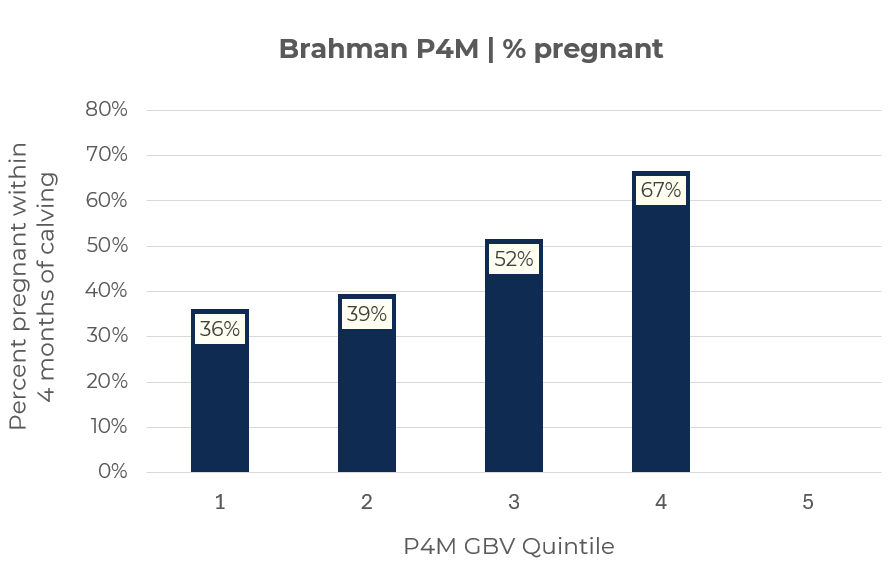
The above-average-genetics females (Q4) were predicted to have a 60-80% re-conception rate, and they achieved 67%. The low-genetic-merit females (Q1) were predicted to have only a 0-20% re-conception rate, but they actually achieved 36%.
The GBVs accurately predicted which group would perform better overall, with a big difference between those with high and low genetic merit. Even though the outcome was not exactly as predicted because of variable effects of nutrition and management, the ranking was still clearly accurate.
The bottom line is that breeding values (eg, GBVs) tell you which animals have the best chance of success, but they're not the whole story. Management, nutrition, and environment all play important roles. The key is to use breeding values to cull animals with low genetic merit, then give all your animals the conditions they need to reach their potential.
Bull selection and buying: Use GBVs as a filter, not a silver bullet
GBVs are a useful strike-off tool. If a bull’s DNA profile flags him as clearly behind, especially on the reproduction traits, move on. Not only does it save time and money, but far more importantly, it ensures you don’t introduce dud genetics into your next generation which can create a nightmarishly long time to rectify.
Selecting the top performer is more complicated. The ‘perfect’ bull exists when you can balance his genetics with your breeding objectives, structural soundness, temperament, adaptability, fertility. All of these are used to make a balanced selection. GBVs (and other breeding values) are a single tool to narrow down the field, not decide a winner. The perfect bull is a unicorn.
Put the numbers to work with management
When 70% of fertility outcomes are management-driven, the wins stack up when GBVs and management pull in the same direction.
The tools are managing the feed base, managing lactation, reducing stress, looking after herd health, and adopting a breeding strategy that works for your business and markets.
Track results & recalibrate
Use your crush side information to guide your GBV decisions. What are your preg test results? Are your cows still lactating? How heavy are your weaners? What date did your bulls go in and when are your calves dropping? How much live weight are you producing in comparison to achievable levels in your situation? Over time, you’ll develop a feedback loop that will help fine-tune the way you use GBVs in your business.
A sensible adoption pathway
1) Calculate you breeding objectives
Establish minimum thresholds for the traits that affect live weight production, sale values and costs.
2) Start where the risk is the lowest and the gain is surest
Use GBVs to remove the tail – the bottom 10 or 20% - from your bull team especially. For example, to mate bulls that are Q1-Q2 for P4M is a strategy that ensures your future female herd will have low fertility. In some circumstances genomics can be profitably applied to replacement heifers. Strategic use of GBVs improves your herd genetic merit immediately and in the long term.
3) Use management to maximise gene expression
Align management of nutrition, lactation, stress and health to give your genetics the best chance to show up in your next generation, eg, in preg test results and weaning data.
4) Measure and learn
Track live weight production plus performance such as pregnancies and cow and calf growth and survival through each cohort and validate the outcomes achieved with your GBVs. If necessary, review breeding objectives, keep what works, drop what doesn’t.
5) Scale and specialise
As you gain confidence and the genetic merit of your herd improves, lean further into genomics to meet breeding objectives, eg, for traits that can improve sale values and or reduce costs. Continue to use GBVs as a filter rather than a single winner-picker.
Genomics is a useful tool, but it is one tool. Used well, it helps you lift the genetic average of your herd and make faster, more accurate decisions with confidence. Used alone, it can’t deliver the 70% of performance that is a consequence of management of nutrition, lactation, health, stress and breeding.
Keep the promise of genomics in perspective: we’re improving the accuracy of the genetic part of the equation. Put that alongside disciplined management and you’ll see the gains where they matter – a business with good tight weaning, more kilos produced per hectare and good business margins.
A few definitions
Genomic accuracy: Confidence in the calculated breeding value, not a promise about next year’s phenotype.
Genomic potential: The proportion of performance that DNA can inform - roughly 30% for fertility in many northern systems.
Phenotypic outcome: What you actually end up with - driven by genetics plus the 70% from management of nutrition, lactation, health and stress.